Showing posts with label Capcom. Show all posts

Saturday, April 23, 2011

Rockman Collector Panic!

With the wonders of game console emulation and near limitless accessibility to files via the interwebs, almost any old generation game is playable by the masses. However, when it comes to Rockman, there is at least one game in this franchise that no amount of emulation or digital piracy will allow you to experience.


Discovery:

It was around '05, after discovering the wonders of surfing Yahoo Auctions Japan (YAJ), that I first laid eyes on a Panic Shot! Rockman cabinet. At the time, my Rockman collection was not quite as mature as it is at present, but I knew I could truly enjoy one such machine adorning my home.
I contacted the proxy bidding service I was using at the time, and my heart broke a little when they notified me that they were not set up to ship such large items. It was a shame, being as I would have gladly paid many times the asking price of the machine just in shipping costs alone. In the 7 or so years I've been using YAJ, I've only seen Panic Shot! Rockman for sale twice. Oddly, the listings were within about 6 months of each other (different sellers) and as I recall, the machines were listed for only 20,000JPY and 15,000JPY. Neither one sold.
As I continued in my Rockman/arcade collecting, I came across a promotional flyer for the game. I figured, if I couldn't get the machine, it would at least be nice to have the sales flyer. I saw the flyer pop up multiple times in my auction surfing, but one day I noticed one that looked a little different. I picked that one up, too. After some studying, it appeared there were two different machines, one of which was ready for production (stock photo), the other a concept sketch.
In '09 I donated scans of my flyers to The Arcade Flyer Archive (TAFA) in lieu of writing this article. While my writing was still in draft form, I came across yet another flyer for this machine.

I put the article on hold until I could get the latest flyer in hand, scanned, and donated to TAFA. Well, you know how laziness/business works (got married, finally settled into a house, etc., etc.). Two years later, the flyer has been scanned, and here's your article.

Differences:

Comparing the 3 flyers shows that there are still only two designs (the 3rd flyer merely replaces the concept sketch flyer). The playfields have totally different artwork, as do the main scoreboard areas.
Also, the hit cards behind Dr. Wily have changed from robot masters to Metalls.
One discrepancy I did notice between the flyers and one of the units I came across on YAJ, is that there is no redemption card dispenser on the auction unit. So, either Capcom made this feature optional, or the YAJ seller decided to remove it from their machine (if you look closely at the photo at the top of the article, there is a line with red print in the instruction box on the header of the machine. This is not stock).

Operation:

The ultimate goal of the game is simple enough: get as many points as possible in order to win a prize. Points are made by hitting either the target hanging below Dr. Wily's UFO or the cards behind him. The rear cards are worth 100 points each, while Wily's UFO target is worth 1000 points. The UFO moves back and forth across the play field, so you can't just keep hitting the same angled shot over and over to rack up those 1000 pointers.
The flyers mention that when the Wily target is hit, the figure features "comical action" and the UFO and back panel lights flash brightly. I imagine some of that "comical action" involves Wily's voice, as the flyers claim that both Wily and Rockman's voices are featured in the game.

After the game is over, the computer calculates the player's total score and, if the "win" light flashes, a prize card is dispensed. I suppose the game center could put in whatever sort of cards they desire, but what is advertised on the machine itself is cards from the Super Barcode Wars Rockman Series. The image above the dispenser shows Blues and Rockman (cards #2 and #1 in the series).

(Top: "Card is gonna come out!", Bottom: "Card Exit")

Inspiration:

To my knowledge, pinball tables are a rarity in Japan, let alone Japanese manufactured ones. That leads me to believe that inspiration for Capcom's mini pinball table came from abroad, namely the US. Certainly one of the most memorable mini pinball machines ever created was Bally's Baby Pac-Man. Bally tried to combine both the video game and pinball table experiences into one machine. Panic Shot! Rockman's similarities to the mini pinball aspect of Baby Pacman are fairly blatant. The play fields are similarly sized, the Ghost cards have been replaced by robots, and some of the other scoring gimmicks are consolidated into Wily's UFO.

Thanks:

Greg Bower - for his superb JP translation help!
Dan @ The Arcade Flyer Archive - for the wonderful service he provides the arcade community!

Tuesday, April 28, 2009

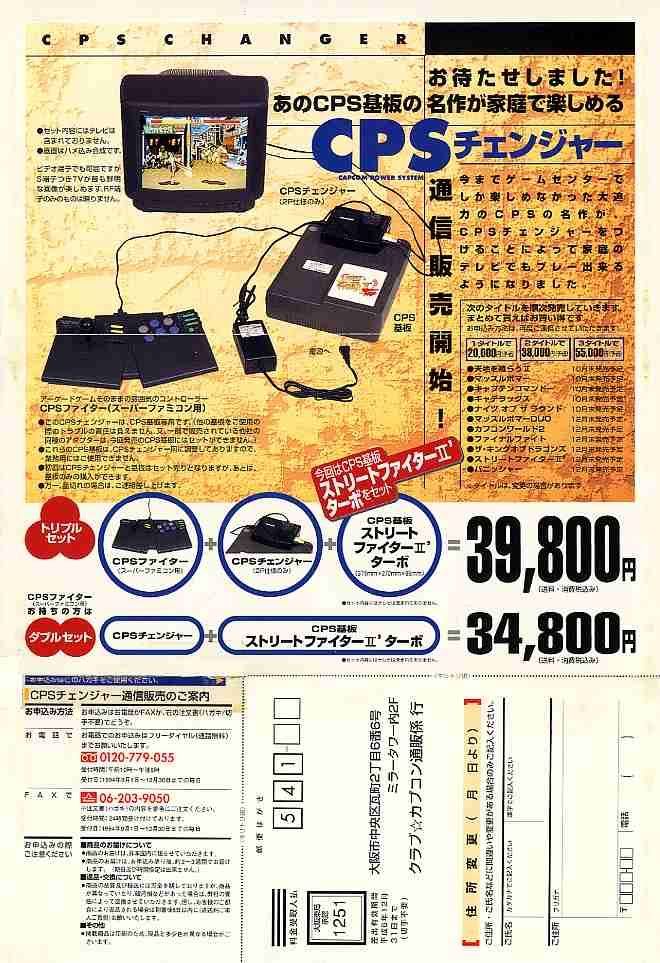
Capcom Power System Changer: Back from the Grave

Don't ask me why, but there has been a resurgence of chatter about the Capcom Power System Changer. So, being as there is still some interest in this thing, that was motivation enough for me to visit my photo archive of "cool crap I've come across on Yahoo Japan Auctions." Rather than jump right into the Changer stuff, let me give you a little history.

Many folks see Capcom's CPS-2 as the product that marked the dawn of the "plastic case era" for this arcade game company. Not true. Others a bit more seasoned would recall a hand full of Capcom's CPS-1 QSound games which had plastic housings. Still not there yet. Capcom actually used plastic housings pre-QSound. The titles I'm aware of are Varth and Capcom World 2. These cases were purely for protection/aesthetics.


Shortly thereafter Capcom secured the rights to use 1Archer's proprietary QSound enhancement technology. At this point Capcom was looking at some changes to their hardware, just to support QSound, so they went ahead and designed a newfangled version of their CPS-1 product. They redesigned the housing (this time fully enclosed), complete with built in cooling fan, external 2volume control, as well as a faceplate with all the aux. connectors. In addition to that, their new electronics boasted anti-piracy technology and left/right RCA jacks for running stereo sound directly to an audio amplifier.

The titles I'm aware of in this format are Tenchi wo Kurau II, Cadillacs Kyouryuu Shin Seiki, The Punisher, Muscle Bomber, and Muscle Bomber Duo (and their respective non-Japan variants). Note that housing color does not indicate region of release, as in the case of CPS-2.

Photobucket

Capcom released their Power System Changer within a year of the last CPS-1 QSound arcade game, which leads me to believe they were working these projects in parallel.

I was overjoyed when a kind soul pointed me to an official Capcom document (many thanks to Summy House) which lists the games for this system. Here is a snapshot of the list:


And here is the translation:
  • Tenchi wo Kurau II
  • Muscle Bomber
  • Captain Commando
  • Cadillacs [Kyouryuu Shin Seiki]
  • Knights of the Round
  • Muscle Bomber Duo
  • Capcom World 2
  • Final Fight
  • King of Dragons
  • Street Fighter II [Turbo]
  • Punisher
As you've probably read elsewhere, Capcom later released Street Fighter Zero. That makes for an even dozen games. I was disappointed to find that I only had photo's of 7 of the 12 titles, but this will at least wet your appetite a little for what was available:

Photobucket

Aside from the original arcade content, some (all?) of the games also had extensive options. Check out the options for Final Fight (button mapping, stage select, etc.):


As you'll read in most descriptions of the system, it makes use of the Capcom Power Stick Fighter.


For those of you not familiar with the unit, there were connections for it to be used on the Nintendo Super Famicom (above), X68000, FM Towns Marty (below), and supposedly the Sega Mega Drive.


Not as fancy as the RF (radio frequency) wireless controllers of the current generation gaming consoles, but Capcom made an IR (infrared) add-on unit which allowed you to un-tether this beastie.


For those of you on the hunt for a Changer, my best recommendation is to keep a keen eye on the arcade section of Yahoo Japan Actions. My experience has been that at least one of these pops up for auction annually. Here are a few more photos of the Changer and games with tasty packaging:


Footnotes:

1. On numerous Capcom flyers advertising QSound, a little disclaimer is included, "QSound Chips have been developed by Archer and incorporate Archer's proprietary QSound sound enhancement technology." The only Archer I could think of was the stereo equipment manufacturer that sold product through Radio Shack stores. Were they a remnant of this Archer? In my curiosity I e-mailed QSound Labs to ask them about this. They promptly replied, "The inventors vended the technology into a company called Archer Communications in 1988. In 1992, we changed the name to QSound Labs, Inc."

2. Aside from the volume dial, there is another dial close to the side. I have no idea what this was meant for, as it is unused on my Slam Masters CPS-1 game.

Links:

NFG's CPS Changer expose